
Intro
There are voices in music that arrive loudly. They announce themselves. They demand attention. And then there are voices that simply exist; already there when you arrive, already woven into the fabric of songs you don’t even realize you love yet. You don’t remember the first time you heard this voice. There’s no single moment, no epiphany. It just feels familiar, like it’s always been part of the music. A presence that slows things down without killing momentum. A voice that never rushes, never overreaches; yet somehow defines the emotional core of the song.
This voice didn’t dominate hip-hop, it stabilized it. It gave it gravity and made space where chaos could breathe. And for decades, whether you knew his name or not, that voice shaped how hip-hop sounded when it wanted to feel human. There are artists whose greatness is measured in numbers. Albums released. Charts topped. Awards collected. And then there are artists whose greatness is measured in absence. You only notice how essential they were once they’re gone. Once the sound they brought quietly disappears from the music itself.
This story isn’t about someone who chased the spotlight. It’s about someone the spotlight kept finding anyway. A voice that didn’t dominate verses, didn’t compete for bars, didn’t need to shout, but somehow became the emotional center of entire records. If you grew up with West Coast hip-hop in the 90’s and early 2000’s like me, you’ve heard this voice more times than you can probably count. Not once or twice, but everywhere. On hooks that softened street records without weakening them. On choruses that felt human in a genre often obsessed with bravado. This is the story of a man who never needed a massive discography to become irreplaceable. A man who redefined what a hook could be. And with that, what it could feel like. This is the story of Nate Dogg.
What A ‘Hook’ Really Is And Why He Changed It Forever
Before we go any further we need to establish something foundational. A hook is the emotional anchor of a track. It’s not just the catchy part; it’s the part that returns, that reassures the listener that they’re grounded. In early hip-hop hooks were often scratched phrases, repeated chants and minimal refrains. They were functional, rhythmic and sometimes aggressive, but rarely emotional. Nate Dogg changed that. He didn’t treat hooks as transitions between verses. He treated them as songs within songs. Melodic statements that carried mood, vulnerability and restraint. His hooks weren’t interruptions, they were destinations. This is the exact reason why artists didn’t just want him for exposure, they wanted him because he completed their records.
Long Beach Roots, Gospel, Discipline & Early Shape
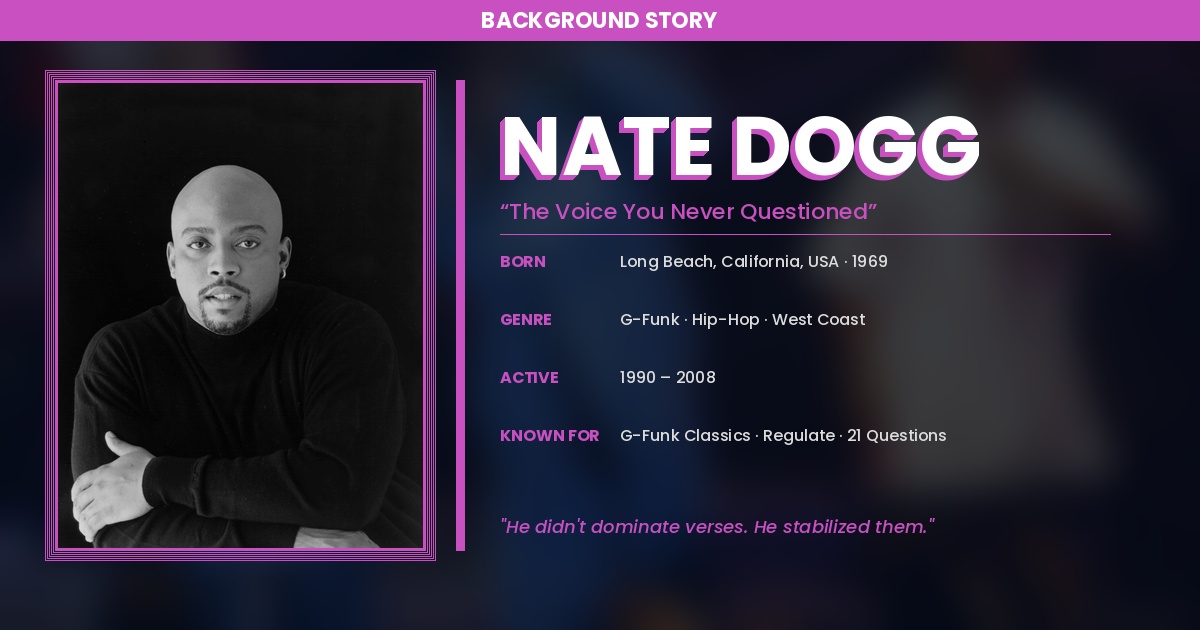
Nathaniel Dwayne Hale was born on August 19, 1969 in Long Beach, California. A city that would later become synonymous with West Coast hip-hop, but at the time was a crossroads of gospel, funk, soul and street reality. Music entered his life early and not casually. When Nate was just four years old his family relocated to Clarksdale, Mississippi. It was there that music stopped being background noise and became structure. His father was a pastor, deeply embedded in the church. His mother led the church choir. Nate didn’t grow up around music, he grew up inside it.
Gospel wasn’t just something he heard; it was something he participated in. Singing in church taught him discipline long before the industry ever could. Breath control. Harmony. Emotional phrasing. Most importantly: restraint. The ability to let silence do part of the work. Those early gospel years mattered more than most people realize. Nate would later cite Marvin Gaye, Stevie Wonder and Maurice White of Earth, Wind & Fire as his primary musical influences. Artists who understood soul not as excess, but as intention. You can hear that lineage clearly in his voice: warmth without strain, emotion without dramatics. That foundation was laid in church.
After his parents divorced Nate returned to Long Beach with his mother. The environment changed, but the discipline stayed. Where Mississippi had given him structure, Long Beach gave him context. Street reality met spiritual grounding. That tension between faith, survival and sound would quietly define everything he did later. Before music became a career Nate joined the United States Marine Corps. He was stationed in Japan. Far removed from Long Beach. Far removed from hip-hop’s epicenter. The Marines didn’t make him a singer, but they sharpened what was already there. Discipline. Precision. Calm under pressure. When he later stepped into recording studios filled with egos, urgency and chaos, he moved differently. Calmly. Patiently. Like someone who had already learned how to wait.
‘213’
Back in Long Beach, Nate reconnected deeply with two people who would shape the rest of his life: Calvin Broadus (Snoop Dogg) and Warren G. Nate and Snoop were real-life cousins, connected not just by shared upbringing but by blood. That familial bond gave their collaboration a depth and trust that went far beyond music. Warren G, meanwhile, was navigating his own path. One that would soon intersect with Dr. Dre in a way that proved pivotal. Together they formed 213, named after the Long Beach area code. This wasn’t a label-constructed group. It was family making music that reflected their environment: slow, melodic and heavy without aggression. Their sound didn’t feel like performance. It felt lived in. That authenticity wasn’t accidental. It came from shared history, shared spaces and literal family ties.
Dr. Dre And The Birth Of G-Funk
When Dr. Dre encountered Nate Dogg’s voice he recognized something hip-hop hadn’t fully absorbed yet: melody as atmosphere. Dre’s production was already cinematic, but Nate’s voice added warmth, patience and emotional gravity. Nate didn’t overpower Dre’s beats; he rested inside them. In 1993 Nate Dogg signed with Dre’s Death Row Records. This matters. Death Row wasn’t just a label. It was a movement. A pressure cooker of ambition, violence, innovation and chaos. And Nate didn’t look like he belonged there. He wasn’t aggressive. He wasn’t theatrical. He didn’t posture. And yet, he became indispensable. While others fought for dominance, Nate offered balance. He became the label’s emotional counterweight.
This is where the term ‘gangsta singing’ begins to make sense. Nate Dogg didn’t invent melody in hip-hop, but he was the first to integrate it seamlessly into gangsta rap without weakening its credibility. He sang about street realities without romanticizing them. He brought soul into spaces that were otherwise hardened. Gangsta singing wasn’t about softness. It was about humanity. And Nate Dogg defined it.
The Collaboration Era • A Quiet Takeover
By the mid 1990’s something unusual started happening in hip-hop. Artists weren’t just looking for beats. They weren’t just looking for verses. They were looking for him. Nate Dogg didn’t arrive with a press rollout or a carefully constructed image. He arrived quietly, often late in the process, sometimes after the song already existed. And yet, once his voice was there, the record suddenly knew what it wanted to be.
Take for example Regulate. By the time Nate’s hook comes in the story hasn’t even begun and yet you already understand the entire emotional landscape. You know this isn’t going to be frantic. You know this isn’t going to rush. His voice doesn’t just introduce the song; it sets the temperature. That pattern kept repeating. On Snoop Dogg’s Doggystyle, especially on tracks like Ain’t No Fun, Nate wasn’t there to clean things up or make them radio-friendly. He was there to give contrast. The subject matter could be raw, unapologetic, even uncomfortable. And Nate’s melody didn’t dilute that. It balanced it. It made the chaos feel intentional, even seductive.
When Dr. Dre called Nate into the studio it wasn’t because he needed a hook filled in. On The Chronic and later on 2001 Nate didn’t announce himself. Sometimes he wasn’t even credited prominently, but his presence lingered. He made Dre’s precision feel human. Years later, 50 Cent would tap into that same instinct. The track 21 Questions only works because Nate Dogg is there. Without him, the song is cold. With him, it becomes vulnerable without ever sounding weak. And then there was Eminem. On Shake That you hear two completely different energies colliding. Eminem is restless, sharp and constantly pushing forward. Nate is unbothered, unhurried and steady. That tension is the point. By this point it didn’t matter who you were or where you were from. Ludacris, Xzibit, Mos Def, Obie Trice. All of them understood the same thing: if Nate Dogg was on your record, it worked.
A Small Discography… And Why That Makes Sense
If you look at Nate Dogg’s catalog on paper it can feel deceptively small. A handful of solo albums. Long gaps between releases. Far more appearances on other people’s records than his own. He did release solo projects: (G-Funk Classics Vol. 1 & 2, Music & Me and Nate Dogg & Friends) and they mattered. They contained moments of undeniable atmosphere, deeply felt grooves and that unmistakable voice. But they never defined his legacy in the way his collaborations did. That isn’t failure. It’s alignment.
Nate understood something most artists spend their entire careers resisting: not every musician is meant to be the center of the room. Some are meant to hold it together. You can hear his influence today in artists who blur the line between rapper and singer without fully committing to either role. In Drake’s early work, where melody becomes emotional framing rather than spectacle. In Ty Dolla Sign’s ability to elevate nearly any track he appears on without claiming it as his own. In Anderson Paak’s instinct to prioritize groove, feel and emotional pocket over technical dominance. None of these artists sound like Nate Dogg. That’s not the point. They operate inside the space he created.
When The Voice Fell Silent
In 2007, Nate Dogg suffered a severe stroke. By then, years of alcohol abuse had taken a toll on his health. Something Nate himself never glamorized or denied. The news didn’t break with spectacle. There were no flashing headlines or public statements filled with urgency. Word traveled quietly in the same way Nate himself always had. The stroke left the left side of his body paralyzed and suddenly the man whose entire legacy rested on control had to relearn how to move through the world at all. But in 2008 a second stroke came. This one took more than mobility. It took clarity. It made speaking difficult. Singing nearly impossible. The instrument that had defined him, the one thing that had always been there, was suddenly unreliable. There is something especially cruel about silence arriving for someone whose life was built on sound.
A Note On Context
Before moving to the conclusion I want to be transparent about the boundaries of this piece. I’m fully aware of the legal allegations and darker chapters in Nate Dogg’s personal history. I haven’t overlooked them. At the same time, this platform exists as a space for people who love music, who care about context and who want to understand how sound, culture and emotion intersect. This annotation is intentionally focused on the music Nate Dogg made and the role he played within it. I’m not closing my eyes to the full picture. I’m choosing the lens.
When The Music Stopped Breathing
On March 15, 2011 Nate Dogg passed away at the age of 41. The reaction across hip-hop wasn’t explosive. It was heavy. It felt like the room had lost oxygen. Snoop Dogg didn’t speak like someone losing a feature artist. He spoke like someone losing a limb: “my cousin, my brother, one of the most important voices of our time. You put the G in G-funk.” There’s grief in that statement, but there’s also recognition. The kind that only arrives when something foundational is gone. Not a star. A pillar. Ludacris said later: “there’s a certain void in hip-hop’s heart that can never be filled.” Not will not be filled. Cannot be.
The Voice That Never Left
Today, Nate Dogg’s influence isn’t confined to a list of songs or a discography you can scroll through. It lives in expectations. Often unspoken, but deeply felt. The expectation that a hook should feel like something. Not just catchy, not just functional, but emotional. The expectation that melody in hip-hop should carry weight, not just gloss. That a song can be confident without being aggressive. Every time a rapper leans into vulnerability without losing credibility. Every time a chorus feels like a place you return to, rather than a line you repeat. Every time a song breathes instead of rushes: that’s Nate Dogg.
He didn’t just shape records. He shaped the way hip-hop learned to slow down. Some voices in music demand attention. Others earn permanence. Nate Dogg didn’t shout. He didn’t rush. He didn’t overstay. He simply arrived and made the song feel complete. His voice wasn’t dominant. It was supportive. It made space for others, and in doing so, made the music feel whole. You don’t always remember the first time you heard Nate Dogg. But you remember the moment the melody settled in. When the mood shifted. When the chorus suddenly felt right. That’s his true legacy. Not a massive catalog. Not a long list of chart-topping albums, but the quiet certainty that every song he touched became better because he was there.